I Tried Everything to Fix the Curve at the Base of My Neck. The One Thing That Finally Worked Wasn’t What a Single Person Had Told Me.
Two years, one drawer full of braces and creams, and the explanation that finally made all of it make sense.

I saw the back of my own neck on a video call last spring, and I couldn’t look away from it.
There was a curve there. Right at the base, where the neck meets the shoulders. A soft rounding I didn’t recognise, the kind that made me look ten years older from the side than I did from the front.
I sat through that whole meeting barely hearing a word. Just staring at the little thumbnail of myself in the corner. When did that happen?
After that, I started doing the things I now know almost every woman with this quietly does. I stopped wearing my hair up — no ponytails, no clips, nothing that left the back of my neck on show. I started choosing tops by how high the collar sat. I tilted my chin down in every photo to soften the curve. And I quietly deleted any picture of me taken from the side.
If you’re reading this and thinking how does she know exactly what I do, it’s because there are a lot of us. And we’re all doing the same small things to hide the same thing.
But here’s what nobody told me for the better part of two years. The reason that curve forms has very little to do with whether you sit up straight. And the reason nothing I tried ever worked is that every single fix was aimed at the wrong thing.
Everything I tried, and exactly why none of it held
What follows is two years of receipts. The posture brace ($45): I wore mine religiously for six weeks. It pulled my shoulders back beautifully while it was on; the moment I took it off, the curve was right back. A brace holds you in a position — it does nothing to the deep muscle pulling you out of that position the second the strap comes off. And the longer you lean on it, the lazier your own muscles get.
Chin tucks and free stretching videos: I did the routine for a couple of weeks. The trouble is, those stretches work the back of the neck — but the muscles that had actually shortened, the ones dragging my head forward, were never being released by any of it. I was stretching around the problem.
The chiropractor ($75 a visit, eight visits): every session felt incredible for about a day and a half. Then the curve came back. The adjustment moved things into place, but nothing released the muscle that had pulled them out of place to begin with. So it slid straight back. Every time.
The cervical pillow ($40) supports your neck while you sleep, which is real and worth having — but it does nothing about the muscle locked up all day at your desk. And the neck creams ($25): I wanted it to be that simple as much as anyone does, but a cream sitting on your skin cannot reach a deep muscle and make it let go. It just can’t.
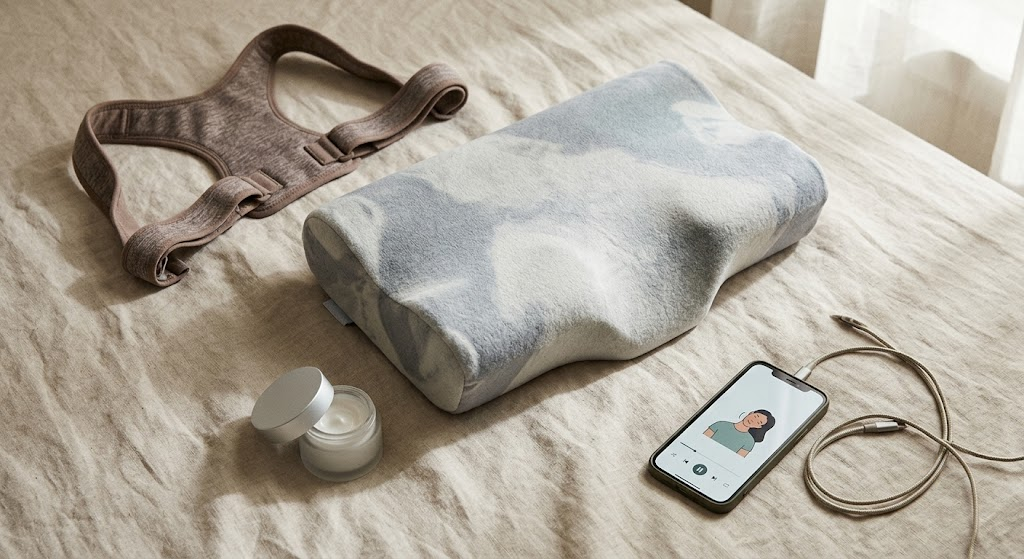
“Every single thing I’d tried had treated the result. Not one had touched the cause.”
It was never my posture. It was a muscle.
Then someone who actually understood necks told me the thing that changed everything. Years of looking down — at phones, at laptops, at everything we hold in our laps — had slowly shortened the deep muscles at the base of my neck. Not damaged them. Shortened them.
And a shortened muscle doesn’t sit there quietly. It pulls. It had been dragging my head forward and letting my upper back round to follow. That rounding was the curve I’d been hiding.
Suddenly all of it made sense. That’s why the brace never worked — it held my shoulders and never touched the muscle. That’s why the chiropractor kept reversing — the thing pulling everything forward was never released. That’s why the stretches felt nice for a day — I was loosening the wrong layer.
Once I understood that, the question I was asking changed completely. It stopped being how do I fix my posture. It became how do I get this muscle to actually let go.

There are only three ways to release a muscle locked up like this
The first is hands-on therapy. A skilled therapist can work the muscle by hand and release it. It genuinely works. The catch is cost and access: sessions run well over a hundred dollars each, a full course is months of them, and you have to turn up at someone’s clinic on their schedule. It works. Most of us can’t sustain it.
The second is to do nothing and hope — the one nobody wants to hear. The muscle doesn’t release on its own while you’re still on screens eight hours a day. Every month you leave it, it locks a little tighter, the curve deepens, and what looks like a small cosmetic thing at forty can settle into something far more set by fifty. Left alone, it only moves one direction.
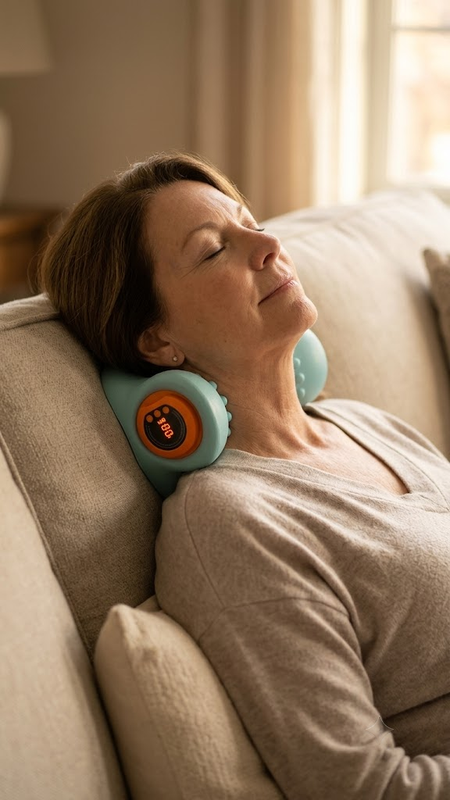
The third is the one I didn’t know existed: releasing it at home. A device that does, in fifteen minutes on your living-room floor, the same kind of deep release a therapist does by hand.
What I ended up using
The one I tried is called the Neckline, and the reason it works where the brace and the stretches and the creams didn’t is simple: it doesn’t hold the muscle, and it doesn’t stretch around it. It gets the muscle to release.
It does four things at once — and that’s the part that matters, because no single one of them is enough on its own. Penetrating heat softens the deep tissue so it’s ready to let go, rather than warmth that just sits on the skin. Gentle electrical stimulation reaches the deep muscle a massage or a stretch never gets near, and coaxes it to release. Soft decompression creates space and lets your head settle back over your shoulders where it’s meant to sit. And deep-tissue massage works the connective tissue holding it all tight.
That exact combination is what you’d pay a clinic thousands a month for. I priced it out once and quietly closed the tab. This, by contrast, was $119.99, once — less than two of my chiropractor visits, and a fraction of the $740 I’d already spent on the drawer.
You lie down. The device does the work. Fifteen minutes, and it builds night over night, each session adding to the last.
What to expect, honestly
The first week, the tightness at the base of your skull starts to ease. Your neck just feels lighter, less like it’s bracing all day. Nothing to see yet.
In weeks two to three, the curve starts to soften. You catch a side-on photo and it looks different, and at first you’re not sure whether you’re imagining it. You’re not.
From week four, the curve visibly settles. Your tops sit differently. And one day you notice you’ve stopped angling your chin down in photos — because you’ve stopped needing to.
From the comments
I saw myself in a photo from my niece’s wedding and ordered this the same night. A month later someone took the same kind of photo, and I actually kept it.
I tried the brace, the pillow, the chiropractor. None of them touched the curve. This is the first thing that’s actually changed the shape of how my neck sits.
I’d watched it get worse every single year. Lining up photos from a few years apart was genuinely frightening. For the first time, I can see it going the other way.
One last thing, because it’s what got me over the line: it comes with a thirty-day, full money-back guarantee, and the return shipping is free. If you don’t see your neck changing in the mirror, you send it back and you’re out nothing. You either see the change, or you get your money back. That’s the whole deal.
— H.R.

The device Hannah writes about is the Neckline 4-in-1 Massager ($119.99 at time of writing, usually $239.98, with a 30-day money-back guarantee and a 2-year warranty). Check availability here →
Disclaimer: This article is for general informational purposes only and reflects one person’s individual experience. It is not medical advice and is not intended to diagnose, treat, cure, or prevent any disease or health condition. The Neckline massager is a personal wellness and relaxation device, not a medical device, and it is not a substitute for professional medical care.
Individual results vary and are not guaranteed. The experiences described here are personal and may not be typical. Any names and images may be used for illustrative purposes. If you have a health concern or a medical condition affecting your neck, back, or circulation, are pregnant, or have an implanted medical device such as a pacemaker, consult a qualified healthcare professional before use.
This content and its claims have not been evaluated by the U.S. Food and Drug Administration.
Three weeks in and my husband asked if I’d changed my hair. I hadn’t — it’s that I’ve started wearing it up again for the first time in years.
What sold me was the muscle explanation. Every other thing I’d bought was aimed at my posture. Once I understood it was a shortened muscle, this was the only thing that made sense.
I’m a photographer and I’d become the person who refuses to be in the picture. I’ve stopped hiding from side angles now. That’s not nothing.
Fifteen minutes while I watch TV. That’s the whole commitment. I kept waiting for the catch and there wasn’t one.
My chiropractor was $80 a session and it never held past a day or two. This was less than two visits and I’m not going back.
The collars of my shirts sit differently now. Small thing, but I notice it every single morning.
Ordered it sceptical. Week four and the curve at the base has visibly softened. I photograph myself from the side every Sunday, so I have the before and after.
Wish I’d found this at 45 instead of 58. Still — it’s moving in the right direction, which I honestly didn’t think was possible anymore.
The heat and the massage together feel wonderful after a day at the desk. That it’s also changing the shape is the real bonus.
I bought the pillow, the brace, two different creams. That drawer of failures cost me more than the device did. Do what I didn’t and skip straight to this.
My daughter noticed before I said a word. “Mum, you’re standing taller.” I hadn’t even told her I was using anything.
Consistency is the trick. I missed a week travelling and could feel the tightness creep back. Back on it and back on track.
Four weeks in. It’s not overnight and it’s not magic — but it’s the first thing that’s actually shifted, and it builds a little more each week.
I’ve stopped tilting my chin down in photos. Didn’t even realise I’d been doing it for years until I stopped needing to.
Honestly bought it for the guarantee — figured I’d try it and send it back. It’s staying.