5 Signs Your Ear Ringing Has Nothing To Do With Your Ears
You were handed a tinnitus diagnosis. The hearing test came back clean. Your ears look perfectly healthy. And yet the ringing never lets up.
So the advice was the usual: sound therapy, white-noise machines, a round of cognitive behavioral therapy, and the line every tinnitus patient dreads — “learn to live with it.”
Here is the part no one mentioned: more than 60% of people diagnosed with tinnitus have compression at the C1–C2 vertebrae that was never once examined. Your auditory system isn’t failing. Something is squeezing the nerves and the blood supply that feed your inner ear.


Pressing Behind Your Ear Changes the Volume
Most people with tinnitus assume the ringing is fixed — a single, unchanging tone. Yours isn’t. Press on certain spots behind your ear and the volume moves. Sometimes it climbs, sometimes the pitch shifts, sometimes one side reacts more than the other.
You probably never brought this up, because it felt like a strange, meaningless quirk. But that quirk is the whole answer.
Ringing from actual hearing damage doesn’t respond to touch — the hair cells in your cochlea are either intact or they aren’t, and no amount of pushing on your neck changes that. Somatic tinnitus — ringing driven by tight muscles and compressed blood vessels — is mechanical. When you press behind your ear, you’re leaning on the very muscles already choking the nerves and blood flow to your inner ear. They tense, the compression briefly increases, and the sound changes with it.
Your audiologist tested your ears and found nothing, because ears were all they checked. It never occurred to anyone that the source might be your neck. In their training, tinnitus is an ear condition, not a muscle one — so when you said touching your neck altered the sound, it was waved off. They missed the single clue that actually mattered.
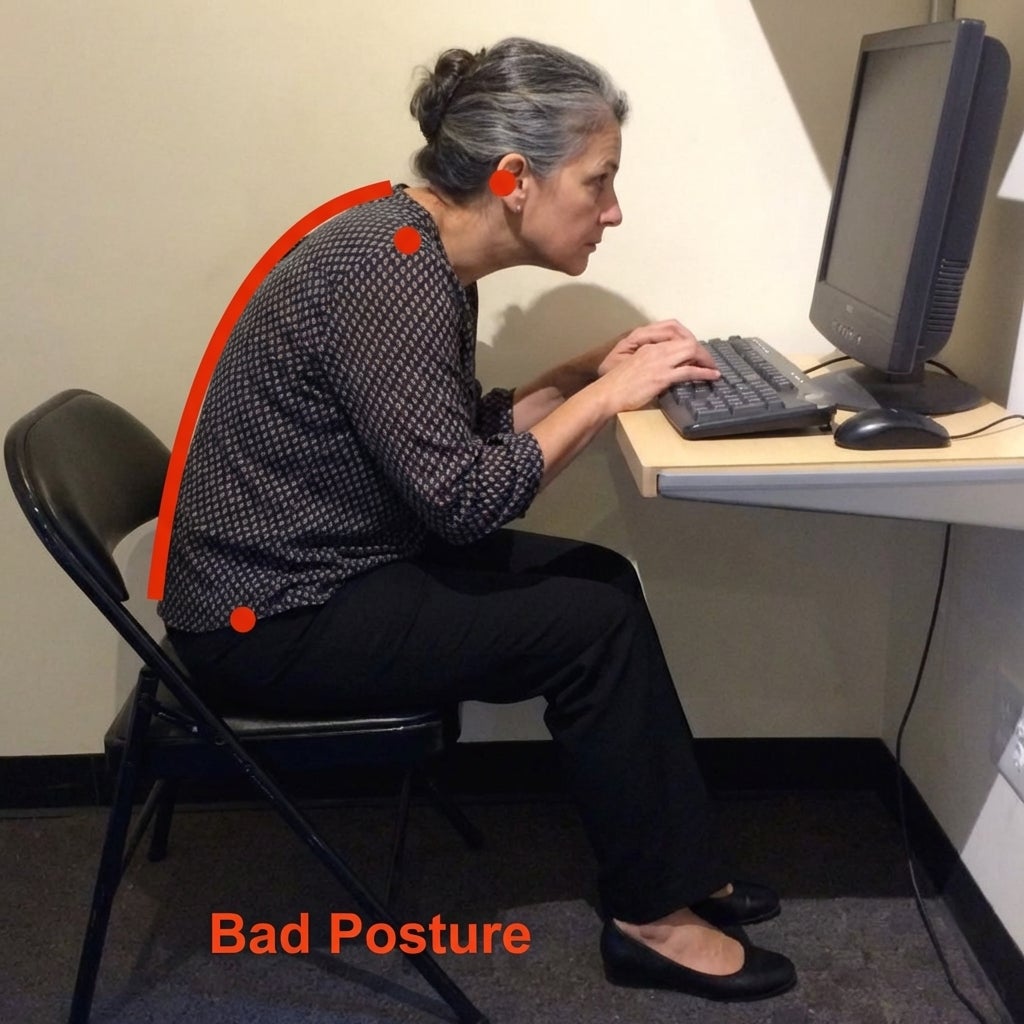
Bad Posture Makes Everything Worse
You’ve seen the pattern for yourself:
- After hours hunched at your desk worse
- After looking down at your phone worse
- After a long stretch in the car worse
- After a night on the wrong pillow worse
Your doctor chalked it up to “stress” or “just tinnitus doing what tinnitus does.” But the classic tinnitus triggers look nothing like yours.
Classic tinnitus triggers
- Loud-noise exposure
- Caffeine
- Alcohol
- High sodium
- Stress
Your triggers
- Neck position
- Sitting too long
- Looking down
- Poor posture
Every time you drop your head to look at your phone, you load your neck with roughly 60 pounds of pressure. Your already-tight C1–C2 muscles clamp down harder, squeezing the vertebral arteries that supply your inner ear. Blood flow falls, your auditory nerves start misfiring, and the ringing climbs. No white-noise machine on earth can un-pinch a compressed blood vessel.

Jaw and Head Movements Trigger Instant Spikes
Snap your head around to check a blind spot — instant spike. Tip your head back — the ringing intensifies. Glance over your shoulder — the volume jumps.
And here’s the piece almost everyone overlooks: your jaw does it too. Clench your teeth — louder. Open wide in the dentist’s chair — louder. Bite into something tough — the ringing flares.
Ordinary tinnitus is indifferent to jaw position. Somatic tinnitus is not. Your jaw muscles — the masseter and temporalis — tie directly into the muscles at the base of your skull. Clenching tugs on the suboccipital muscles at C1–C2, the same ones already pressing on your vertebral arteries. The tension travels, the compression tightens, blood flow drops, and your auditory system answers in an instant — the ringing explodes.
Your audiologist tested your hearing across a range of frequencies, but never once asked you to move your jaw and listen for a change. In their model, tinnitus is a story about damaged hair cells — not tension spreading from jaw to neck. So when you described movement triggers, there was simply no explanation to offer. The idea that your own muscles were behind all of it never came up.
You Have Constant Neck and Jaw Tension
You mention the dull ache at the base of your skull. The tight jaw. The shoulder knots that never fully let go. Your ENT nods and says it’s “just the stress of living with tinnitus.”
Except here’s the catch: tinnitus doesn’t come bundled with neck pain. Aching necks aren’t part of the condition. But in people with somatic tinnitus, neck and jaw tension are almost always in the picture.
That ache at the base of your skull? Those are your suboccipital muscles — tiny, deep muscles at C1–C2 sitting right on top of your vertebral arteries. When they stay chronically tight, they crush the vessels feeding your inner ear. Less oxygen reaches your auditory nerves, they begin to misfire, and your brain reads the scrambled signals as sound: ringing, buzzing, hissing that no one else can hear. Your neck isn’t reacting to your tinnitus — your neck is causing it.
Your Hearing Test Is Normal
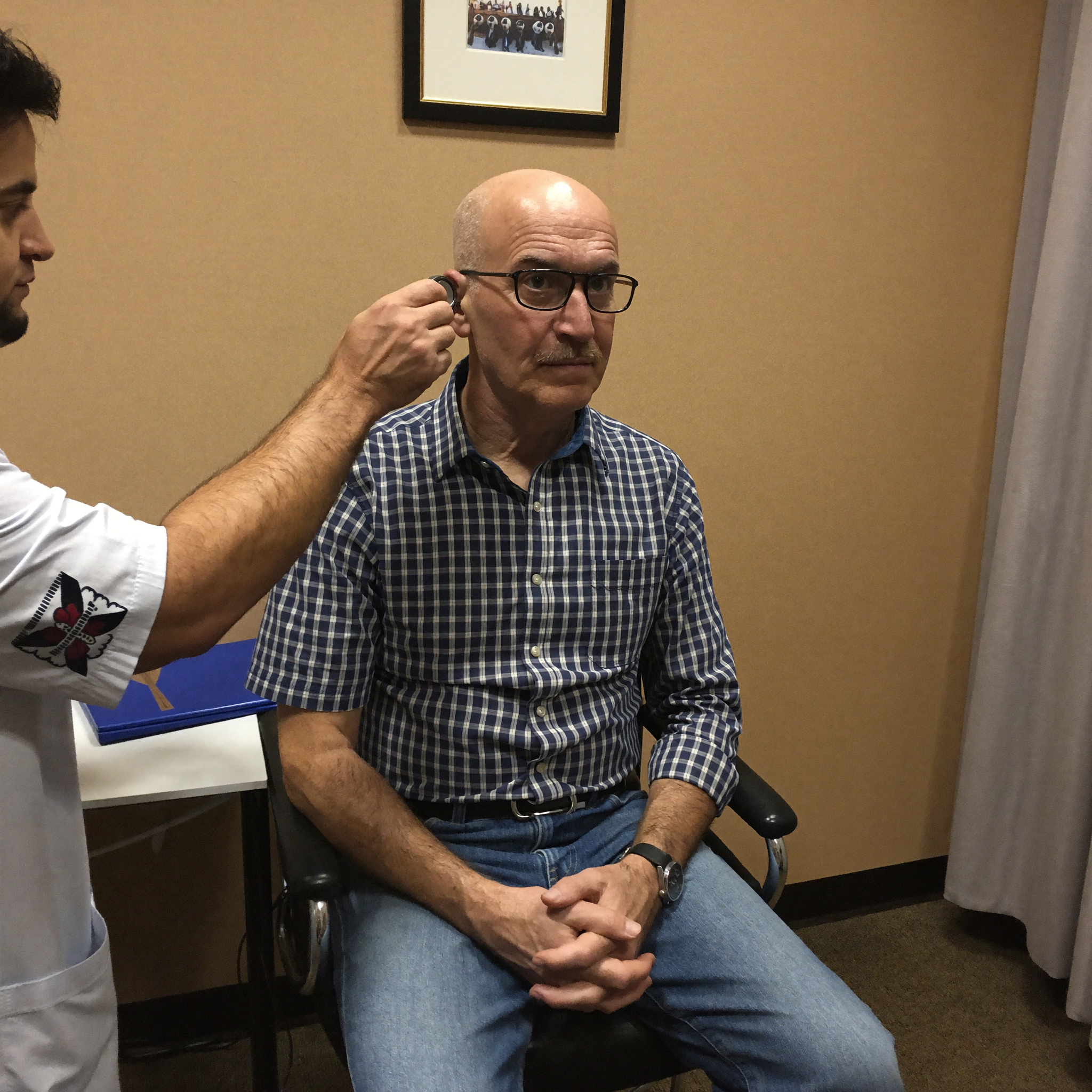
You walked into the audiologist expecting answers. They ran a full hearing test, swept every frequency, looked inside your ears. “Your hearing is perfect,” they said. “It’s just tinnitus. There’s no cure. You’ll have to learn to live with it.”
You left feeling brushed aside — as if your suffering didn’t count because a test came back clean. But look at what that normal result actually tells you: your cochlea is fine. Your hair cells aren’t damaged. Your auditory system works exactly as designed.
So why the endless ringing? Because the trouble was never in your ears — it’s in the blood supply to them. When the suboccipital muscles at C1–C2 pinch your vertebral arteries, your inner ear is starved of oxygen. Your auditory nerves lose the fuel they need and start firing erratically, and your brain turns that noise into sound. A hearing test can’t detect vascular compression. An audiogram can’t see tight muscles strangling blood flow. That’s how your test read normal while the ringing screamed. They were measuring the wrong thing.

4 Out of 5 People With Somatic Tinnitus Are Misdiagnosed
The reason is simple: most audiologists never look at your neck. They test your hearing, inspect the ear canal, run a tympanometry. The hearing test reads normal. The verdict comes back: tinnitus, no cure, learn to live with it.
What got skipped? Your neck was never part of the workup. Research shows that when patients labeled with “idiopathic tinnitus” are actually treated for neck compression — hands-on therapy, deep muscle release, and traction at C1–C2 — more than 80% see a meaningful drop in symptoms.
But most audiologists have never encountered that research. Hearing-aid companies can’t patent a neck treatment, and no profit means no education. So you keep being told there’s no cure — for a problem that was never examined in the first place.
So What IS Somatic Tinnitus?
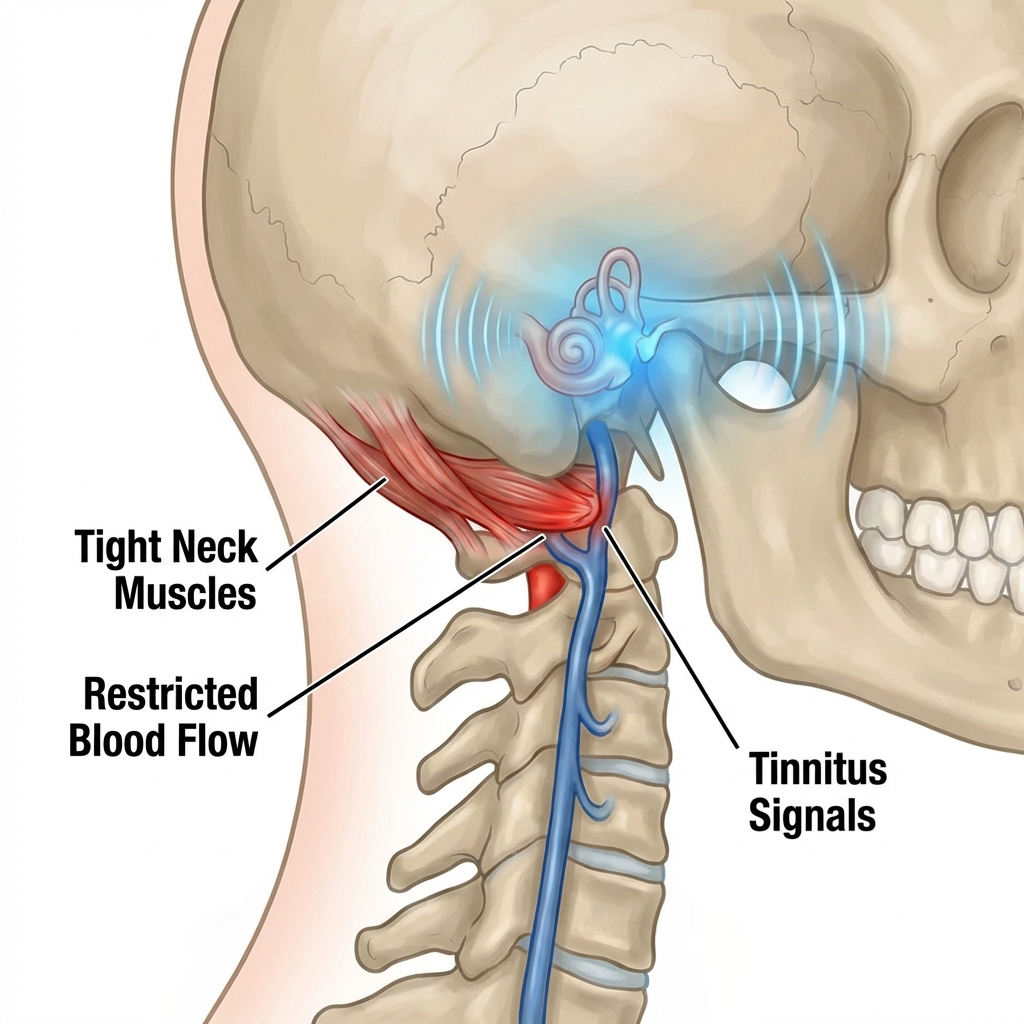
It’s tinnitus-like symptoms produced by compressed structures at C1–C2 — the exact spot where your skull meets your spine. When the deep muscles at the base of your skull lock up chronically, they:
- Compress your vertebral arteries, cutting blood flow to the inner ear
- Compress your cervical nerves, causing referred pain and jaw tension
- Disrupt proprioceptive signals, so your brain gets faulty information about head position
Which explains all of it:
- Why pressing behind your ear changes the volume
- Why bad posture makes it worse
- Why jaw and head movements trigger spikes
- Why you carry constant neck and jaw tension
- Why your hearing test is normal
- Why sound therapy does nothing
Your blood vessels have to be decompressed. Your muscles have to release. Nothing short of that will fix this.

Recent Research Confirms the Neck–Tinnitus Connection
A 2023 study in Otology & Neurotology followed patients diagnosed with idiopathic tinnitus who also had persistent neck tension. They were treated specifically for cervical compression — deep heat therapy, electrical muscle stimulation, and cervical traction at C1–C2.
The outcome: 85% reported major symptom relief within 4–6 weeks. Ringing dropped in volume. Spikes faded. The quiet moments came back.
Yet most audiologists have never seen this work. So people keep “managing” incurable tinnitus when the real culprit was compressed blood vessels at the base of the skull all along.
Over 47,000 People Have Found Relief With Neckline
Meet the device that’s rewriting the story. Neckline uses a precisely engineered 26-degree angle, positioned exactly where those deep cervical muscles sit at C1–C2.
How it works:
The result? Compressed structures open up. Blood flows freely to your inner ear again. Your auditory nerves stop misfiring. The ringing fades. The spikes stop. The quiet comes back.
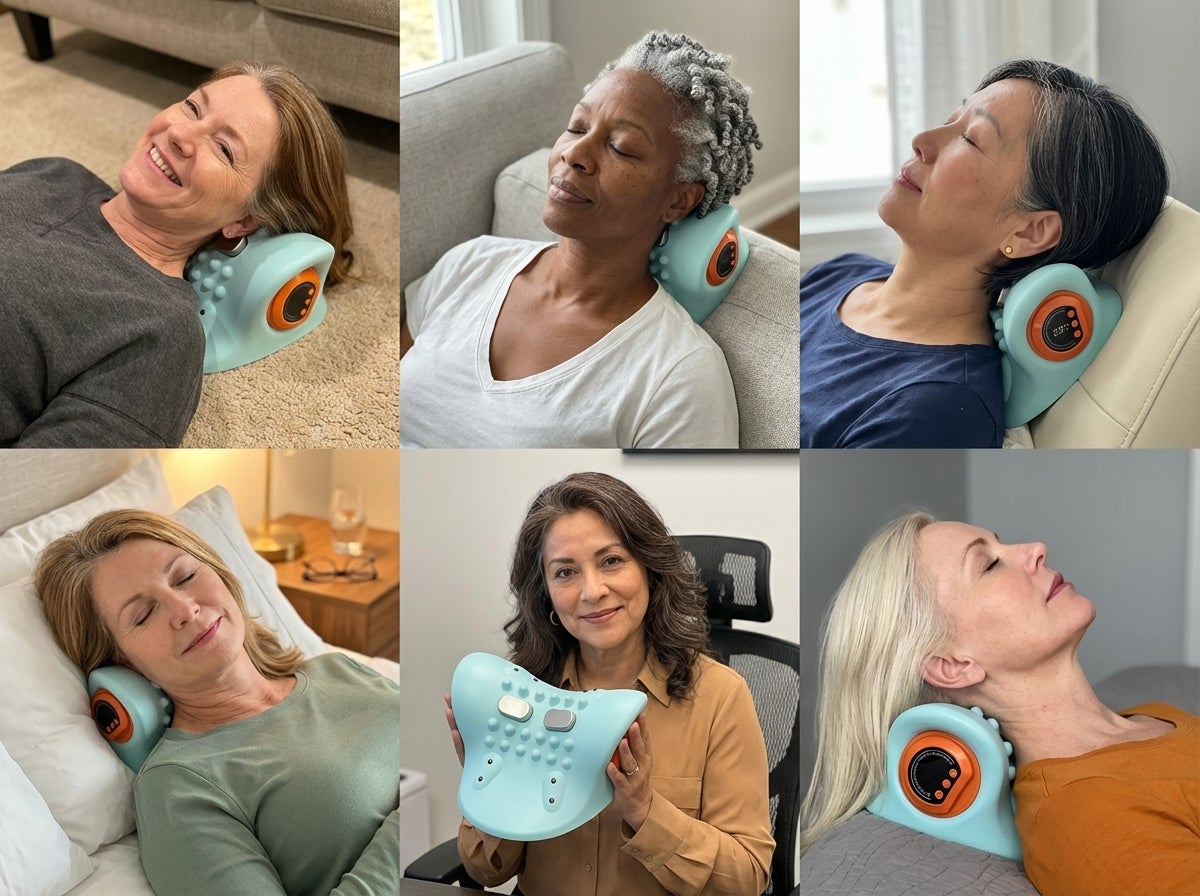
What Others Are Saying
“They told me I had tinnitus when I was 49. I dropped $1,400 on sound therapy and got exactly nothing out of it. Two weeks into using Neckline, the steady ringing went from an 8 down to about a 3. It had been somatic tinnitus the entire time and nobody caught it.”
“Five years of white-noise machines and sleeping pills, and I still woke up to that screaming in my head. I started using Neckline every day, and within three weeks I had my first genuinely silent morning in half a decade. My audiologist couldn’t believe it.”
“Normal hearing test, textbook tinnitus diagnosis — and not one thing helped. This device decompressed my neck and my ‘incurable’ ringing all but vanished. I can watch TV without the subtitles now.”
A Message From Rachel, The Founder
I know exactly what’s going through your head right now: “Another gadget? One more thing that’s going to let me down?”
I spent 11 years treating cervical dysfunction before the tinnitus link finally clicked for me. Once I started actually examining C1–C2 in patients labeled with “idiopathic tinnitus,” the same picture kept showing up: suboccipital muscles locked tight, vertebral arteries pinched, blood flow to the inner ear choked off.
Whenever I released that compression by hand, people who’d lived with ringing for years started turning the corner within a few weeks. The problem was that I could only see about 20 patients a week.
That’s the reason I built Neckline® — to deliver that same cervical decompression at home, without the waiting list.
Why Hasn’t Your Audiologist Told You About This?
Because, honestly, they don’t know it exists.
A standard tinnitus workup almost never includes an examination of the neck. When you show up with ringing, they run hearing tests, tympanometry, maybe an MRI. But an actual neck exam — checking the muscle tension at C1–C2? That’s rarely part of the protocol.
Research shows neck compression is present in over 60% of patients with unexplained tinnitus. But if no one checks the neck, no one will ever find it.
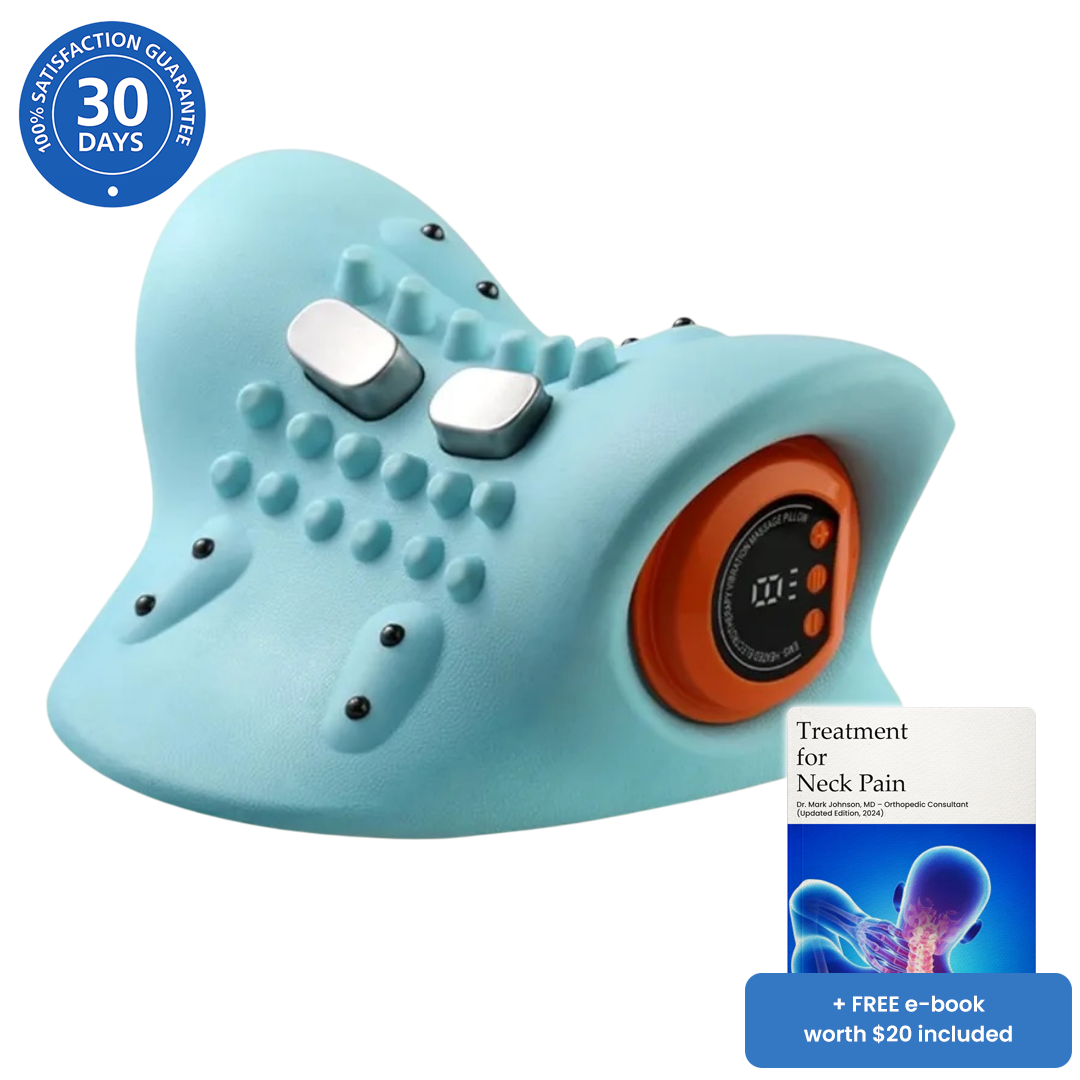
Neckline™ — 50% Off + Free Shipping
As an exclusive deal for readers of my blog, Neckline is offering 50% off plus free shipping to every new customer. But this only holds while inventory lasts — and my contacts inside the company tell me they expect to be completely sold out within 2 hours.
On top of that, you get 30 days to put your Neckline to the test. If it’s not for you, for any reason at all, you get a full refund — no questions asked.
And remember, there’s a steep discount for ordering two — 89% of Neckline customers grab a pair, one to gift and one as a backup.
