 Trending in the US
Doctors Keep Missing This: The 15-Minute Solution Eliminating Mystery Symptoms in Over 47,000 People
The culprit? Your neck.
Dr. Michael Chen, a brain and nerve specialist at Stanford Medical Center, recently examined 847 patients who came in with ongoing dizziness, blurred vision, and anxiety.
What he uncovered was hard to believe.
89% of them had already been put on antidepressants or anti-anxiety medication. Plenty had been told the whole thing was "all in their head."
But once Dr. Chen actually looked at their necks, the real issue was staring back at him: every single patient had pinched nerves in the cervical spine — the neck bones that shield your spinal cord.
Your Neck Controls More Than You Think

Most people have no idea how much their neck is quietly running.
The seven bones in your neck guard the nerve pathways that direct your whole body. Those nerves shape your balance, your vision, your heart rate — even how clearly you think.
When those bones drift out of alignment — from slouching, endless phone time, or an old injury — they press on the nerves. Doctors call the fallout a "cascade effect."
First, the pinched nerves start firing the wrong signals up to your brain. Your vision blurs. You feel dizzy. Pressure builds behind your eyes.
Second, the compression chokes off blood flow to your brain. You feel drained and foggy. Anxiety starts to creep in.
Third, your nervous system begins to short-circuit. Your heart races. Panic hits for no reason at all. You just can't settle.
Here's the unsettling part: none of these symptoms feel like they have anything to do with your neck.
And that's exactly why your doctor keeps overlooking it.
Why Doctors Get It Wrong

Sarah Mitchell, 43, burned through two full years bouncing between specialists.
Not a single one of them thought to check her neck.
Sarah's experience isn't the exception — it's the rule.
As Dr. Chen puts it: "If you have dizziness, you get sent to an ENT. Vision trouble sends you to an ophthalmologist. Anxiety lands you with a psychiatrist. Every specialist stays inside their own lane. Nobody stops to examine the neck."
The outcome? Millions of prescriptions that only paper over the symptoms without touching the real problem.
And all the while, the neck compression keeps getting worse.
Why Normal Treatments Don't Work

Even on the rare occasion the neck does get flagged, the usual treatments miss the mark.
Painkillers just dull the ache — they do nothing for the pinched nerves underneath.
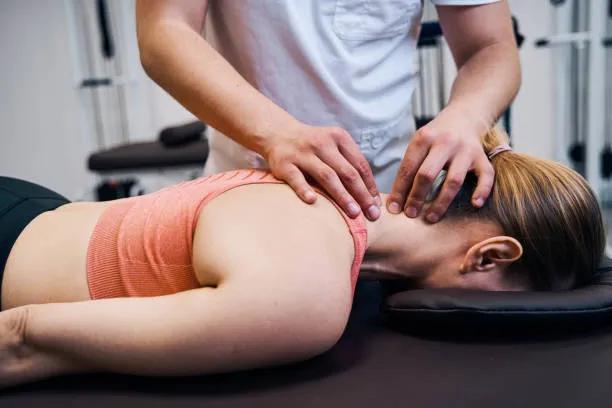
Ordinary massage and stretching feel great for an hour, but they only work the surface muscles. The deep muscles where the real compression lives stay locked tight.
Physical therapy can help, yet it drags on for months at $150–300 a visit.
Chiropractic adjustments carry real risk — a bad neck manipulation can trigger a stroke.
And surgery runs into tens of thousands of dollars with months of recovery on the other side.
That's what pushed Dr. Chen to start hunting for a better answer.
The Four-Part Solution That Actually Works
Dr. Chen's research turned up something striking: combining four specific therapies at once outperformed anything used on its own.
Part 1: Electric Muscle Stimulation (EMS)
EMS sends gentle electrical pulses deep into the neck muscles that ordinary massage can never reach. The pulses make the muscle contract and release, loosening tension that's built up over years. Studies show EMS engages deep muscle up to 300% more than regular exercise.
Part 2: Heat Therapy
Heat widens the blood vessels and drives more blood to your brain, delivering fresh oxygen and flushing out the waste trapped in tight tissue. Research from Johns Hopkins found targeted heat raised neck blood flow by 47% in just 15 minutes.
Part 3: Deep Massage
Unlike surface rubbing, deep-tissue work hits the precise spots where the compression forms, switching on your body's natural "calm and repair" response.
Part 4: Neck Traction
This is the key. Gentle stretching opens up space between the neck bones and takes the load off the pinched nerves — the same idea a chiropractor uses, only safer and gentler. Put together, these four don't just mask symptoms — they correct the actual structural problem.
But How Can the SAME $3,000/Month Clinical Solution Now Cost $119.99?
Dr. Chen's protocol worked remarkably well. Patients felt dramatically better inside of two weeks.
But there was one glaring catch: the price. Getting all four therapies meant several appointments a week across different offices, and insurance almost never picked up the tab.
Most people were paying $200–300 per session, two or three times a week.
Over a single month that stacked up to $2,500–4,000.
"We had something that genuinely worked," Dr. Chen said. "The trouble was that only well-off patients could ever afford it."
That's the gap medical-device engineer Thomas Keller set out to close.
What if a single device could deliver all four therapies at home?
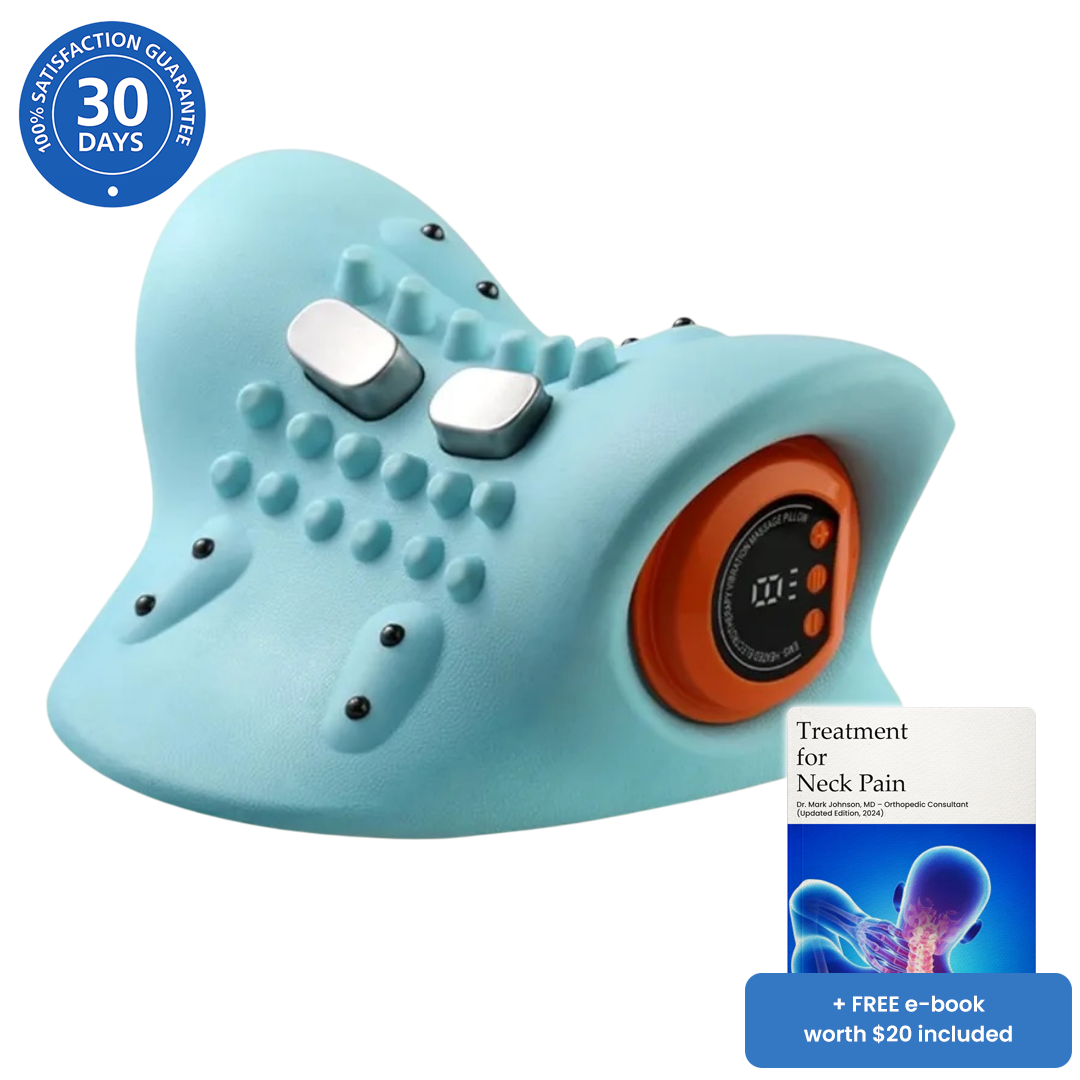
After 18 months of development he built Neckline — a home unit that runs the same four clinical therapies at the same time.
Medical-grade technology. Professional-level results. Home-use convenience.
All for $119.99.
But not for long.
The regular price is $239.98. Right now Neckline is running its annual relief campaign — 50% off to help as many people as possible skip the costly clinic visits during the high-pain winter stretch. Once the promotion ends, the price goes back to $239.98.
From $3,000/Month Clinical Treatments to Your Living Room
The Neckline device folds every part of Dr. Chen's four-step clinical protocol into one unit:
- Medical-grade EMS that reaches the deep muscles (in place of specialist electrical stimulation)
- Therapeutic heat set to the exact temperature used in clinical settings
- Precision massage points positioned right where the compression forms (mimicking hands-on therapy)
- Gentle cervical traction that safely opens space between the vertebrae (in place of physical-therapy sessions)
You use it for 15 minutes a day.
Dr. Chen was doubtful at first. Could a home device really match the results of his $200-a-session clinical protocol?
So Dr. Richardson's team ran it on 50 patients who had already tried everything — pills, physical therapy, chiropractic care — with no lasting relief.
The results caught them off guard. After two weeks of daily 15-minute sessions:
- 94% had significantly less neck pain
- 87% experienced reduced dizziness
- 83% noticed clearer thinking
- 79% felt less anxious
- 76% slept better
"These numbers matched — and in some cases beat — what we were seeing in the clinic," Dr. Chen said. "Except patients were getting there at home, on their own schedule, without the $3,000-a-month bill."
Real People, Real Relief
Jennifer Walsh, 38, lived with unexplained symptoms for three years. "There was this constant pressure in my head, like it was clamped in a vise. My hands would go numb behind the wheel. I'd stand up and the room would spin. Doctors screened me for MS, brain tumors, inner-ear disorders — and every result came back empty." A friend mentioned Neckline. She was doubtful, but by that point she was desperate.
Robert Brown, 52, was dealing with daily heart palpitations and panic attacks. "I was convinced I was having heart attacks. I ended up in the ER four separate times. They'd run every test, tell me my heart was perfectly fine, and send me home. The anxiety was taking over my life."
His doctor finally examined his neck and found a severe Atlas misalignment.
And these aren't one-off flukes. Over 47,000 people report similar results.
Why This Works When Everything Else Failed
The difference comes down to two things: depth and completeness.
Pills only cover up the symptoms. Basic massage barely touches the surface muscles. Stretching never reaches the root compression.
Neckline's four-part clinical protocol addresses the problem at every level:
- The EMS releases deep muscle tension that's been building for years
- The heat restores blood flow to oxygen-starved tissue
- The massage calms an overworked nervous system
- The traction frees the pinched nerves driving your symptoms
Together they don't merely hide symptoms — they restore normal cervical function. Exactly the way Dr. Chen's $3,000-a-month protocol does.
What You're Probably Spending Now
Add up what you're already handing over:
- Pain medication: $50–200/month, indefinitely
- Specialist visits: $150–400 per appointment
- Physical therapy: $150–300 per session, 2–3x weekly
- Chiropractic adjustments: $75–200 per visit
- Workdays lost to feeling awful: priceless
Most people pour thousands into treating symptoms that never improve, because none of it touches the cervical compression underneath.
Neckline costs $119.99 (regular price $239.98). One-time payment. Use it as long as you like. That's less than a single specialist visit.
The 30-Day Guarantee
Here's what makes this completely risk-free:
Use Neckline for 30 days. If your symptoms don't clearly improve — if you don't feel the mental clarity, the reduced pain, and the relief that over 47,000 others have — send it back for a full refund. No questions asked.
Dr. Chen and Dr. Richardson stand behind that offer because they've watched the results firsthand. Fewer than 1.3% of customers ever ask for a refund.
What Happens If You Don't Act

Here's the hard truth about cervical compression: it doesn't fix itself. It gets worse.
Every day the Atlas stays out of place, your nervous system takes on more interference. The symptoms intensify. The dizziness shows up more often. The anxiety digs deeper. The pain spreads.
What could be relieved in two weeks now might take months later — or turn permanent.
Dr. Chen doesn't sugar-coat it: "Atlas misalignment causes progressive nerve damage. The longer you wait, the harder it is to reverse. I've seen patients who put it off for years develop neurological problems that became permanent, simply because the compression sat there too severe for too long."
Your Two Choices

Choice 1: Keep swallowing pills that only mask the symptoms. Keep seeing specialists who treat everything except your Atlas. Keep hoping it sorts itself out. (It won't.)
Choice 2: Go straight at the real source with the same four-part clinical protocol that's helping thousands clear their mystery symptoms in just 15 minutes a day — without the $3,000-a-month price tag.
Sarah Mitchell, who spent two years being misdiagnosed, sums it up: "I burned through more than $8,000 on specialists, tests, and medications that led nowhere. Neckline cost me $119.99 and gave me my life back. My only regret is not finding it sooner."
Tap the button below to see if it's still in stock. If it is, your discount is applied automatically.
Neckline®
- Relieves neck and back pain
- Prevents dizziness and migraines
- Eases pain from herniated discs
- Reduces stiffness and improves mobility