
Doctors Keep Missing This: The Real Reason Your ‘Carpal Tunnel’ Won’t Respond to Treatment
Thousands are being treated for wrist problems when the real culprit is hiding in their neck
June 2026 — New research is exposing a troubling pattern in medicine: patients diagnosed with carpal tunnel syndrome who aren’t responding to treatment because they never had carpal tunnel at all.
The real problem? A pinched nerve in their neck.
Dr. Jennifer Walsh, a neurologist at Johns Hopkins Medical Center, recently reviewed 623 patients who’d been diagnosed with carpal tunnel and failed to improve with standard treatments.
What she discovered was shocking.
87% had been wearing wrist braces for over a year with no relief.
Many had negative EMG tests but were told to “keep treating it anyway.”
But when Dr. Walsh examined their cervical spines (the neck bones that protect your spinal cord), she found the actual source:
Every single patient had nerve compression in their neck—specifically at the C6 and C7 vertebrae.
The nerves being squeezed weren’t in their wrists at all.
Your Neck Controls More Than You Think

Most people don’t realize how much power their neck has over the rest of their body.
The nerves that make your hands work—the ones that let you type, drive, hold a coffee cup, button your shirt—don’t start in your wrists.
They start at the base of your skull.
From there, they travel down through seven neck vertebrae, wind through tight shoulder muscles, pass down your arm, and finally reach your fingertips.
That’s a long journey through a lot of potential trouble spots.
And when your cervical curve is destroyed—flattened from years of looking down at phones, hunching over desks, or old whiplash injuries that never fully healed—those nerves get compressed at the source.
This creates what doctors call a “cascade effect.”
First, the squeezed nerves send wrong signals down your arm.
Burning. Tingling. Numbness in your thumb, index, and middle fingers—exactly like carpal tunnel.
Second, the compression weakens your grip.
You start dropping things. Coffee mugs slip from your hand. Keys fall when you try to unlock the door.
Third, pain shoots from your wrist up into your forearm.
Sometimes it radiates all the way to your shoulder and neck. But because it hurts most at your wrist, that’s where everyone looks.
Fourth, your hands go completely numb at night.
You wake up at 3 AM shaking your hands trying to get feeling back. The wrist brace doesn’t help because the pressure isn’t coming from your wrist at all.
Here’s the scary part:
These symptoms are identical to carpal tunnel syndrome.
Same burning. Same tingling. Same numbness pattern.
That’s exactly why your doctor keeps missing it.
Why Doctors Get It Wrong

Patricia Morrison, 51, spent three years being treated for carpal tunnel.
“I wore the brace religiously. I had two cortisone shots. I did physical therapy for my wrist twice a week,” she says.
Nothing worked.
“Finally they ordered the EMG—the nerve test that’s supposed to confirm carpal tunnel. I was so sure it would show how bad my wrist was.”
The test came back negative.
“I remember the doctor looking confused. He said, ‘Well, a negative test doesn’t rule it out. Some people have carpal tunnel even with a clean EMG. Let’s just keep treating it.’”
Patricia kept wearing the brace. Her hands kept getting worse.
“I started avoiding holding my grandkids because I was afraid I’d drop them. I stopped writing thank-you notes because my handwriting looked like a child’s scrawl. I felt like I was losing my independence one dropped object at a time.”
What nobody told Patricia—what most doctors don’t realize—is this:
An EMG tests nerve function at the wrist.
If the nerve compression is happening higher up in your neck, the wrist test comes back normal.
You have real symptoms. Real burning. Real weakness.
But the test is looking in the wrong place.
Dr. Walsh explains: “When a patient presents with hand numbness and tingling, we’re trained to test for carpal tunnel. We look at the median nerve where it passes through the wrist. But if that nerve is being compressed at C6 or C7 in the cervical spine, the EMG won’t show it—because we’re testing too far downstream.”
The result?
Thousands of negative EMG tests in patients with severe hand symptoms.
And doctors who keep treating carpal tunnel that was never there.
Why Normal Treatments Don’t Work

The problem is that most doctors never suspect the neck.
They see hand numbness and tingling, and they immediately think: carpal tunnel.
So they treat your wrist.
- Wrist braces immobilize the wrong joint. The compression is happening eight inches higher in your neck.
- Cortisone shots reduce inflammation at your wrist, but do nothing for the pinched nerve at the base of your skull.
- Physical therapy for the hand strengthens wrist muscles while the neck muscles that are actually squeezing the nerve remain tight and locked.
- Anti-inflammatory medication masks the pain without releasing the structural compression causing it.
- Surgery on the wrist can’t help if the problem was never in your carpal tunnel to begin with.
Even in the rare cases when a doctor does suspect cervical involvement, they often just add neck stretches to your hand therapy—which isn’t enough to release years of deep muscle tension and nerve compression.
That’s why Dr. Walsh started looking for a better approach.
The Four-Part Protocol That Actually Works
Dr. Walsh’s research found something interesting:
Using four specific treatments together worked better than anything else.
Part 1: Electric Muscle Stimulation (EMS)
EMS sends gentle electric pulses deep into your neck muscles—the ones regular massage can’t reach. These pulses make the muscles contract and release, breaking up years of tension. Studies show EMS activates deep muscles 300% more than regular exercise.
Part 2: Heat Therapy
Heat opens up your blood vessels, increasing blood flow to your neck. This brings more oxygen to the tight muscles strangling your nerves and clears out waste products that have built up over years. Research from Johns Hopkins found that targeted heat increased neck blood flow by 47% in just 15 minutes.
Part 3: Deep Massage
Unlike surface massage, deep tissue work hits the exact spots where blockages form. This releases the muscles that are strangling your nerves at the source.
Part 4: Neck Traction
This is the key. Gentle stretching creates space between your neck bones, taking pressure off pinched nerves. It’s what chiropractors do, but safer and gentler.
Together, these four don’t just cover up symptoms—they fix the actual structural problem.
But How Can the SAME $3,000/Month Clinical Treatment Now Cost $119.99?
Dr. Walsh’s treatment worked amazingly well. Patients regained hand function within two weeks.
But there was a big problem: cost.
Getting all four treatments meant multiple appointments every week at different places. Insurance rarely covered it.
Most people paid $200-300 per session, 2-3 times weekly.
Over a month, that added up to $2,500-4,000.
“We had something that worked,” Dr. Walsh said. “But only wealthy patients could access it.”
That’s when medical device engineer Thomas Keller saw an opportunity.
What if all four treatments could be delivered by ONE device at home?
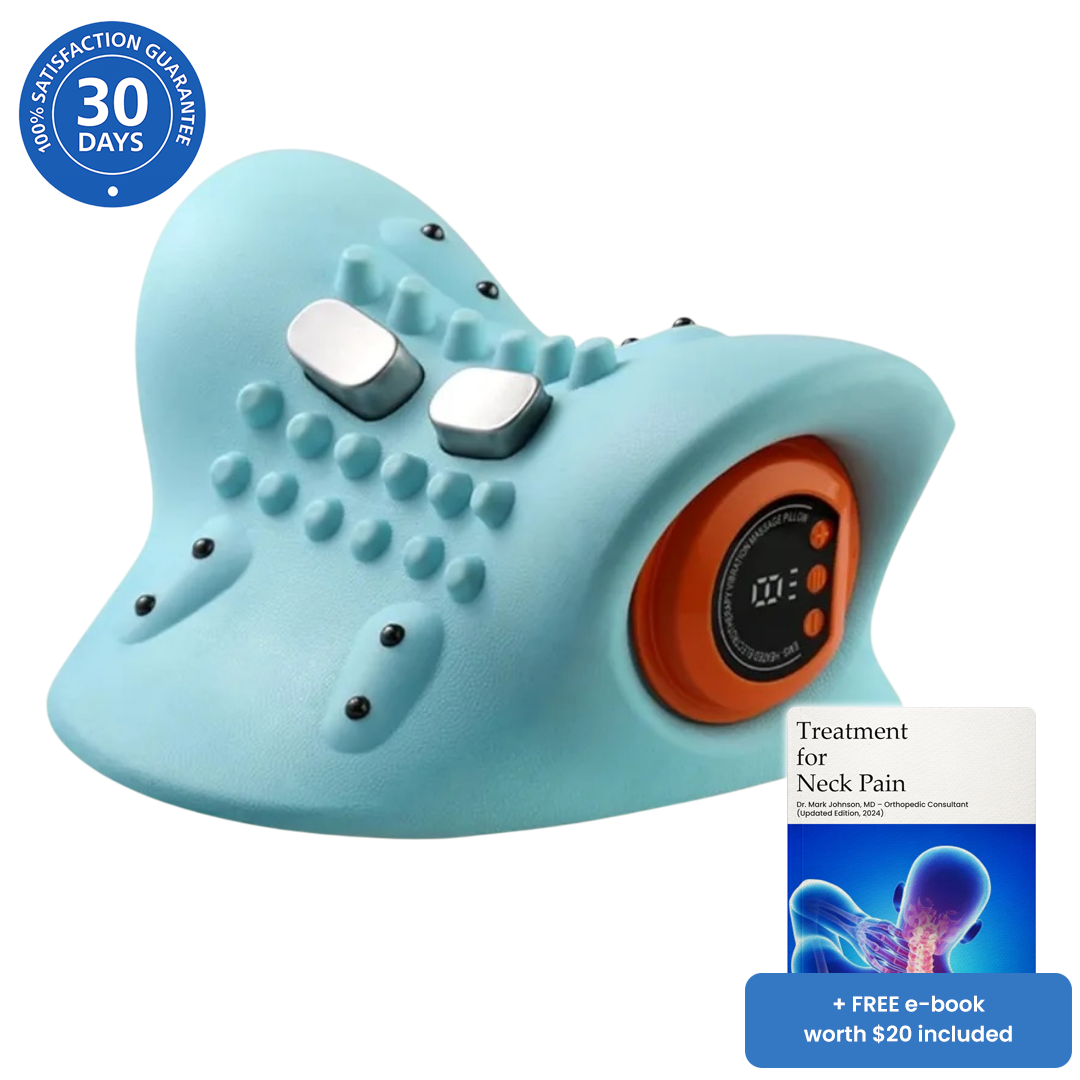
After 18 months of development, he created Neckline—a home device that delivers the same four clinical treatments simultaneously.
Medical-grade technology. Professional-level results. Home-use convenience.
All for $119.99.
But not for long.
The regular price is $239.98. But right now, Neckline is running their annual relief campaign—offering 50% off to help as many people as possible avoid expensive clinical treatments during the high-pain winter months.
Once the promotional period ends, the price returns to $239.98.
From $3,000/Month Clinical Protocol to Your Living Room
The Neckline device puts everything from Dr. Walsh’s four-part clinical protocol into one unit:
- Medical-grade EMS that reaches deep muscles (replacing specialist electrical stimulation)
- Therapeutic heat set to the exact temperature used in clinical settings
- Precision massage points positioned where blockages form (mimicking manual therapy)
- Gentle cervical traction that safely creates space between vertebrae (replacing physical therapy sessions)
You use it for 15 minutes a day.
Dr. Walsh was skeptical at first. Could a home device really deliver the same results as her $200-per-session clinical protocol?
Her team tested it on 50 patients who’d already tried everything—wrist braces, cortisone shots, hand therapy—without relief.
The results shocked them.
After two weeks of daily 15-minute sessions:
“These results matched—and sometimes exceeded—what we were seeing in the clinic,” Dr. Walsh said.
“Except patients were getting them at home, on their own schedule, without the $3,000/month price tag.”
Real People, Real Relief
Jennifer Davis, 47, suffered from hand numbness for four years.
“I wore wrist braces to bed every night. I had three cortisone shots. I did months of hand therapy. My EMG came back negative twice, but they kept telling me it was carpal tunnel. Nothing worked.”
A coworker told her about Neckline. She didn’t believe it would work but was desperate.
“Within the first week, I could hold my coffee mug without my fingers going numb. By week two, I stopped dropping my keys. After a month, I held my granddaughter’s tea set without dropping a single cup for the first time in years.”
Robert Chen, 54, dealt with hand weakness so severe he couldn’t open jars.
“My right hand was useless. I’d been diagnosed with carpal tunnel in both hands. They wanted to do surgery. I was terrified of losing more function.”
His sister convinced him to try Neckline first.
“I started using it twice a day. The tingling decreased within three days. My grip strength came back after about two weeks. I canceled the surgery. I couldn’t believe something so simple fixed what doctors couldn’t.”
These aren’t rare cases. Over 47,000 people report similar results.
Why This Works When Medications Failed
The difference is simple: depth and completeness.
Wrist braces immobilize the wrong joint. Cortisone shots reduce inflammation in the wrong place. Hand therapy strengthens muscles that aren’t causing the problem.
Neckline’s four-part clinical protocol fixes the problem at every level:
- The EMS breaks up deep neck muscle tension that’s been there for years
- The heat restores blood flow down your arm
- The massage releases the muscles strangling your nerves
- The traction creates space where the nerve compression actually happens
Together, they don’t just hide symptoms—they restore normal nerve function.
The same way Dr. Walsh’s $3,000/month protocol does.
What You’re Probably Spending Now

Think about what you’re already paying:
Most people spend thousands treating a wrist problem that never existed because the real compression is in their neck.
Neckline costs $119.99 (regular price $239.98).
One-time payment. Use it forever.
That’s less than one cortisone shot.
The 30-Day Guarantee

Here’s what makes this completely risk-free:
Use Neckline for 30 days.
If your hand symptoms don’t dramatically improve—if you don’t regain grip strength, stop dropping things, and sleep through the night like over 47,000 others have—send it back for a full refund.
No questions asked.
Dr. Walsh offers this because she’s seen the results.
Less than 1.3% of customers request refunds.
What Happens If You Don’t Act

Here’s the truth about cervical nerve compression:
It doesn’t get better on its own. It gets worse.
Every day those neck muscles stay tight, your nerves suffer more damage. Hand function deteriorates.
The numbness happens more often.
Your grip gets weaker.
You drop more things.
What could be relieved in two weeks now might take months later—or become permanent nerve damage.
Dr. Walsh is blunt about this:
“Cervical compression creates progressive nerve damage. The longer you wait, the harder it becomes to reverse. I’ve seen patients who waited years lose permanent hand function because the nerve compression was too severe for too long.”
Your Two Choices

Choice 1:
Keep wearing wrist braces that don’t work. Keep getting cortisone shots that wear off. Keep seeing hand specialists who treat everything except your neck. Keep hoping things improve on their own. (They won’t.)
Choice 2:
Address the actual source with the same four-part clinical protocol that’s helping thousands regain full hand function in just 15 minutes a day—without the $3,000/month cost.
Patricia Morrison, who spent three years being misdiagnosed, says it best:
“I spent over $8,000 on wrist braces, shots, hand therapy, and tests that all came back negative. Neckline cost me $119.99 and gave me my hands back. I only wish I’d found it sooner.”
Click the button below to check if it’s still in stock. If it is, your discount will be applied automatically.
 Relieves neck and back pain
- Prevents dizziness and migraines
- Relieves pain caused by herniated discs
- Reduces stiffness and improves mobility